 |
|

Indiana Jones and the Fate of Atlantis(PC) (E) (Adventure) |
|||
Great adventure with some flaws.
Indiana Jones and the Fate of Atlantis is one of a huge series that many people have grown to overlook over the years- the Lucasarts Adventure game. Way back when, when Lucasarts had pretty much (For the time being) figured out the Star Wars franchise was old and everyone was somewhat sick of Tie Fighter games, they put themselves in new fields, namely, adventure games. They developed their own system, and pumped out great adventure games that totally immersed the gamer in record times to tons of happy gamers. Nowadays, these games are overlooked, but I felt like Gametrash needed a review of one once in a while, so here we go again.
Indiana Jones and the Fate of Atlantis is the second in the "Indana Jones" series of adventure games that basically profited off the wildly popular series (This came out in 1992, the Last Crusade came out in 1989, but Lucasarts continued to mess with the license over the years, including the horrible "Young Indiana Jones" TV series). Indiana Jones is a professor by day, but spends most of his free time exploring hidden tombs and caves, looking for hidden Archeological treasure to put them in museums. The series delights in coming up with odd theories and mystical ancient histories that Indie discovers and puts right, whipping around with his trademark bullwhip and hat. This game starts off with Indie causing problems, ala the "Monkey Island" series many Lucasarts fans know well. The story slowly unfolds with the mystery of Atlantis and the discovery that Atlantis may be more than just a myth. By using your brain and taking one of three unique paths, you will discover Atlantis and, well, considering it's an Indiana Jones game, you stop the Nazis from continuing to mess around. The bastards. 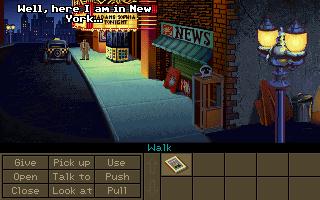 Indiana Jones and the Fate of Atlantis plays like any other major Lucasarts adventure. You play with the mouse, clicking on buttons on the bottom of the screen for actions, such as "Look at" or "Pick up". The graphics on top present all dialogue, text, and areas, and your inventory is displayed below for use on the top. It's very simple and innovative, and I could play these games with no problem even as a kid. This moves into complex puzzles which test your ability to critically think, such as a puzzle where you read writings by Plato and try to figure out what the alignment of certain disks should be. These aren't easy puzzles, but nonetheless, hardened adventure gamers won't sweat a drop at them. Of course, just like any other Lucasarts adventure, Indiana Jones and the Fate of Atlantis features unique and fun puzzles. Instead of being stuck matching ancient ruins all the time, 75% of all the puzzles are based around your general ability to think creatively. For example, in the start of the game, you want to talk to a woman doing a lecture. Do you wait or go through some sort of complex story like other games would force you to? Nope. Work your way in the back of the stage and screw with her lighting. She'll get mad and come to you. Simple as anything, somewhat funny, and it keeps you from being completely bored with the puzzles. Here's the part where I diverge from normal opinions on this game. Honestly, I did not find this game to be as amazing as it's bretheren, such as the Monkey Island series. The game is notably short and somewhat easy, and really doesn't require the thinking or creativity other Lucasarts adventures forced you into. Don't get me wrong, the game HAS that, but not to the same extent. Being quite a bit more serious than other Lucasarts adventures, it also somewhat places itself into a position where you don't know if you should laugh or consider it a serious adventure. It's not that huge of a deal, but it confused me a bit. 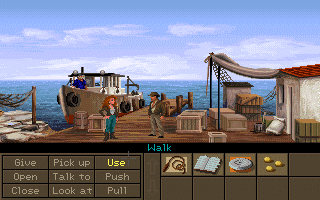 Another part of irritation is some of the cheap ways in which the game makes itself hard. Out of the blue, without any kind of tutorial or guide, the game puts you in some sort of contrived fighting mode. Of course, it also specifically forgets to tell you how to fight effectively, and you can end up getting pummeled by a Nazi (And losing the game) by just sheer ignorance. The game features "Action Sequences" such as this that honestly feel out of place and extremely hard to work with the mouse, and they really should have never been featured. Games like The Secret of Monkey Island, a game on the same engine, not only never featured something so redundant or irritating, but it would never kill you off for being ignorant. I ended up losing an hour's worth of gameplay this way. The game features three pathways to take mid-game (Which all inevitably end the same, but the paths you take to get there are different), so the game is rather long, but one way through the game ends up only being 3 hours of solid gameplay, barring some sort of mental freeze. This isn't very good, because when other games like Maniac Mansion, Sam and Max, or Day of the Tentacle tend to at least make you spend time on it, this game seems to blow through rather quickly. Sure, I could replay through the game THREE TIMES, but the three modes are so similar, that it really isn't worth it. It's dissapointing, because if you REALLY expanded this system, the game could have been much more deep- and maybe much longer. When all is said and done, Indiana Jones and the Fate of Atlantis is one of those games that gets shoved in the bottom of my drawer, but I wouldn't give it up. It's an outstanding adventure game, worthy of anyone's collection- but when you compare it to games on the same engine with the same company, you really find out quickly that the game could have been much better. So, in that sense, I'm rating this game based against what it could have been. Sure, that's somewhat unfair, but it's true. There are many other Lucasarts adventure games like this worth getting, but this would be close to the end of my list for purchases, under great games like Monkey Island and Sam and Max.
|
|||