 |
|
The Wii- a complete rundownby Kirk, 2006-04-17 |
||||
The System- a quick rundownIntel Broadway CPU (Rumored at 729MHz) ATI "Hollywood" GPU (Rumored at 243 MHz ) Unknown amount of RAM (But rumored at 24 MBs of "Main Ram" and 64 of "External") 512 MBs of Flash Memory WiFi by Broadcom Slot loading disc drive for 12cm Optical Wii discs, 8.0cm Gamecube discs, and (With an attachment), standard DVD discs Two USB ports, two SD memory card slots, two Gamecube controller ports, and two Gamecube memory card slots Thoughts and Commentary These specs are very vague, and for a good reason. From day one, when this system was released at E3 in 2004, it has been very obvious that Nintendo cares very little about what kind of specs this system has, and seems to be focusing more on the actual games on it. That being said, this is still the first time any company in the gaming industry has purposefully underpowered their system compared to their competitiors.  Other than the somewhat clever nomenclature of the CPU and GPU, one cannot say much about this system at this point. Personally, I've felt like it's taking a more Apple attempt to the Microsoft market, which is an interesting way to handle the increasing pressure the industry is putting on graphics and overall power capability. The really interesting thing here is that unlike other Nintendo systems, a lot of effort has been put into making sure this system runs Gamecube games- which will be nice to bolster the library. One other thing to note is that Nintendo has quite honestly come out and said that the system will not support Advanced HDTV. This is predictable, considering that HD images take much more processing power to generate, as well as the general fact that Nintendo fans aren't the type to buy $3000 HDTVs. Some complain this will limit the system, but newer reports suggest that since the system will support EDTV anyway (480p, what DVDs do natively), this will not be a problem for the lifespan of the system. Something odd hits me about this system, and I'm not sure if it's foolish paranoia or what- the Nintendo Wii doesn't have an actual Ethernet jack, but actually seems to run completely on WiFi. For those of us running it now (And you should anyway, especially if you have a Nintendo DS) this is fine, but it may harm purists loving the long Ethernet cord. The Controller- Looks like my TV Remote.The Nintendo Wii controller is a one handed unit looking essentially like a very thick Television remote. It, unlike any controller before it, has the capability to not only sense motion, but depth, positioning and targeting- all in the real world space. That being said, the controller is made to be moved around as if a real item or gun, and is meant to interact with the television, much like an extremely upgraded version of Nintendo's famous Zapper light guns for NES games like Duck Hunt and Operation Wolf. 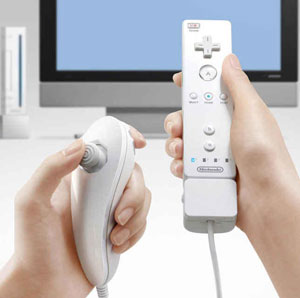 The controller is expandable and interchangeable with many displayed concepts, like the Nunchuck format that Nintendo released originally, which essentially is an addition for the player's left hand which resembles the left hand side of the Nintendo Gamecube controller, an analog stick for movement attaching to the bottom of the Wii controller. Other additions have been announced such as a compatible Nintendo Gamecube controller in which the Wii controller slides down into, as well as adapters for Nintendo 64, SNES, NES, and other gaming consoles the system will support. Thoughts and Commentary By far the most controversial aspect of the system, the Nintendo Wii controller has been called genius, stupidity, and the next biggest thing in TV Controlling technology. Let's face it- it looks like a television remote with a trigger on it. But, when one sits down and looks at the system with scrutiny, it becomes very obvious that there is some reason for this, and talk about the applications only bolsters this reason to a very clean and realistic Good idea. For example, one of the biggest examples people have given in support of this play method is games like Red Steel, which will allow you to actively swing a sword and use a gun in modern Japan. This is a phenomenal idea, because nothing spells awesome to gamers than being IN a game, instead of being tied to unrealistic control schemes, such as WASD and the mouse. I'm personally very excited about the concept of using a sword in a realistic fashion in the game (Though I can foresee myself breaking a lot of furniture), but I can acknowledge some problems with the control scheme. One of the main issues with this scheme is that gamers usually like sitting down and relaxing in games, and may not have the energy or stamina to put a lot of action into their gameplay. It's a great idea to have me swing that aforementioned sword, but if I'm tired after a long day and just want to kick back with some games, I doubt I want to play underwear samurai in my living room. Hopefully, many games will realize this and cut back on the overt use of the controller (And in many cases, they will hopefully keep the motion to a minimum, or at least configurable). One of my worries from a technological standpoint is the 0-axis positioning setup that many of us don't realize. Ever wondered why games tell you not to touch your control sticks when you turn on a game console? It's because it sets the 0 axis- the point in which the X and Y values of your control stick are 0. So, if you were to pull down on the control stick while turning on the system, your stick would naturally spring back up, and the system would read it as pushing upward- thus a problem. The real issue here is how that would be found on the Nintendo Wii controller. Would I have to perfectly position it in my hand before I turned on the console? What if I move backwards or around the room? What if I drop it? There are a lot of questions I want answered before I end up turning the system on with the controller between my legs (Which would lead to some truly awesome Red Steel playing, in my opinion).
|
|
|||

